In Saudi Arabia, getting a POS terminal can look as simple as buying any piece of equipment for your business. Start comparing offers, though, and the picture quickly gets more complicated. Merchant fees vary from one bank to another, commissions change with the card type, and some providers attach conditions to approving you in the first place, plus separate conditions for waiving the monthly fee.
Before you decide which POS terminal fits your business, you need to know exactly what you will pay, and what you get in return. How much does the service provider charge? How much do you pay in mada fees as a merchant? The market is full of offers; banks that install the terminal with no setup fees, others that impose a minimum sales threshold, and fintech companies whose digital solutions bundle extra benefits into the device.
That is exactly where this guide comes in. We lay out everything you need to know about POS terminal prices and merchant fees, from setup charges to commissions to the differences between banks and fintech providers. Our goal is that you know the true cost before you make a decision or sign any contract.
What Is A POS Terminal?
It is an electronic device that lets a merchant accept electronic payments through mada cards, Visa, Mastercard, or digital wallets, with the amount transferred directly to the merchant’s bank account.
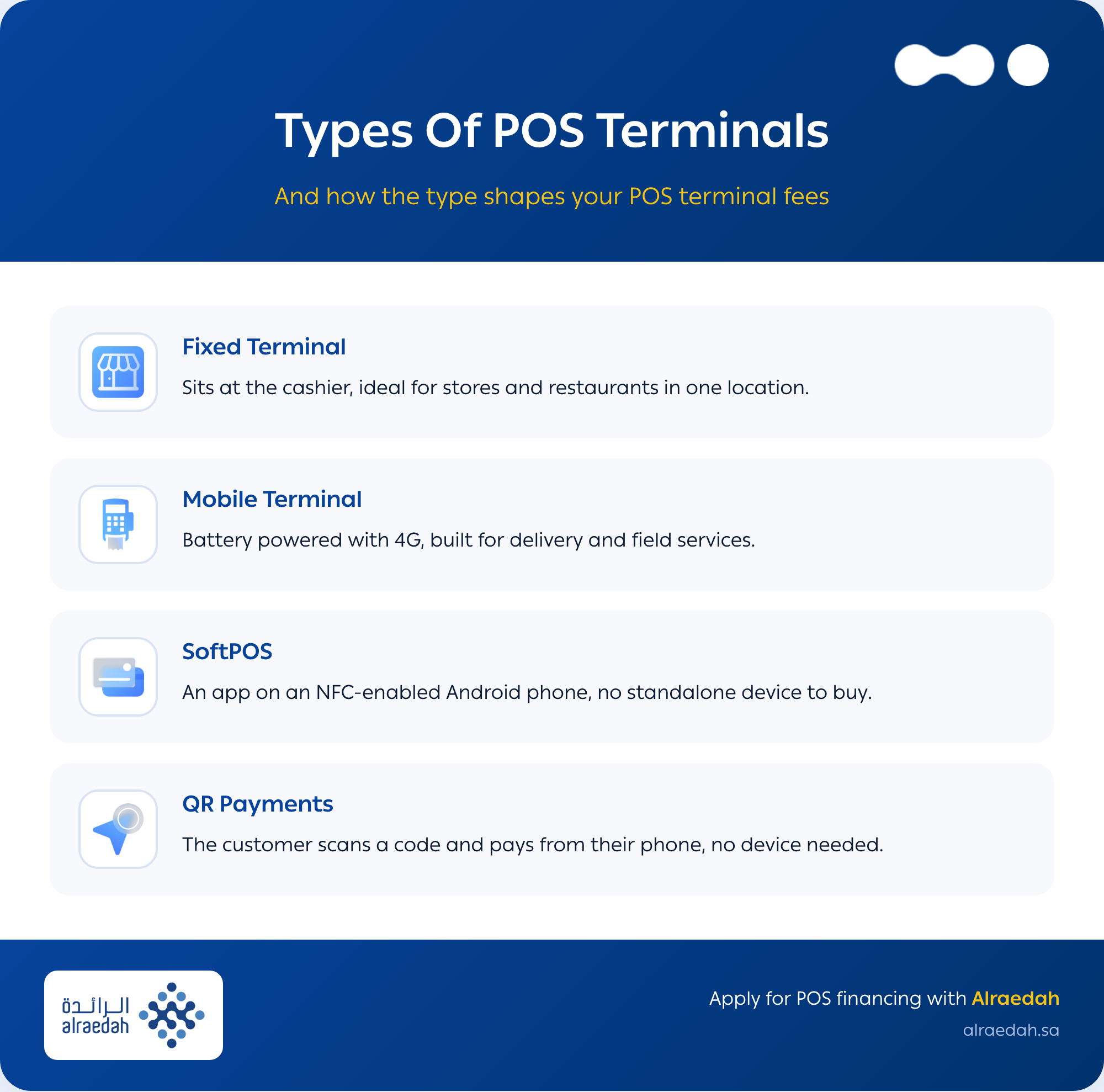
POS terminals come in several types:
- Fixed: sits at the cashier, ideal for shops and restaurants. It runs on a phone line or a wired/wireless internet connection, and suits businesses that operate from a single location.
- Mobile: battery powered with 4G, built for delivery work and field services.
- SoftPOS:
- An app installed on Android phones (version 10+ with NFC).
- No standalone device to buy.
- A good fit for small ventures or businesses that need maximum flexibility.
- QR Pay:
- No physical device at all; the customer scans a code and pays from their own phone.
- Common at kiosks, events, and pop-up markets.
What Is The mada Network, And How Does It Shape POS Terminal Fees?
mada is Saudi Arabia’s national payments network, established and supervised by the Saudi Central Bank (SAMA). It connects every ATM and POS terminal in the Kingdom through a central gateway that routes each transaction to the card’s issuing bank, whether local or an international scheme such as Visa or Mastercard.
The mada network’s role covers:
- Guaranteeing security and speed across all electronic payments inside the Kingdom.
- Standardizing acceptance rules between banks and service providers, so any customer can pay at any point of sale.
- Setting the overall fee framework: mada states that the commission on purchases over its network is capped at 0.8% of the transaction value, and never more than SAR 40 per transaction.
- Supporting multiple payment methods through traditional POS terminals, SoftPOS apps on smartphones, or online payments.
Worth remembering: mada does not sell or lease POS terminals to merchants. It provides the infrastructure the devices run on, while banks and fintech companies supply the terminals and set their own fees and conditions within mada’s framework.
The Factors That Drive POS Terminal Prices And Fees
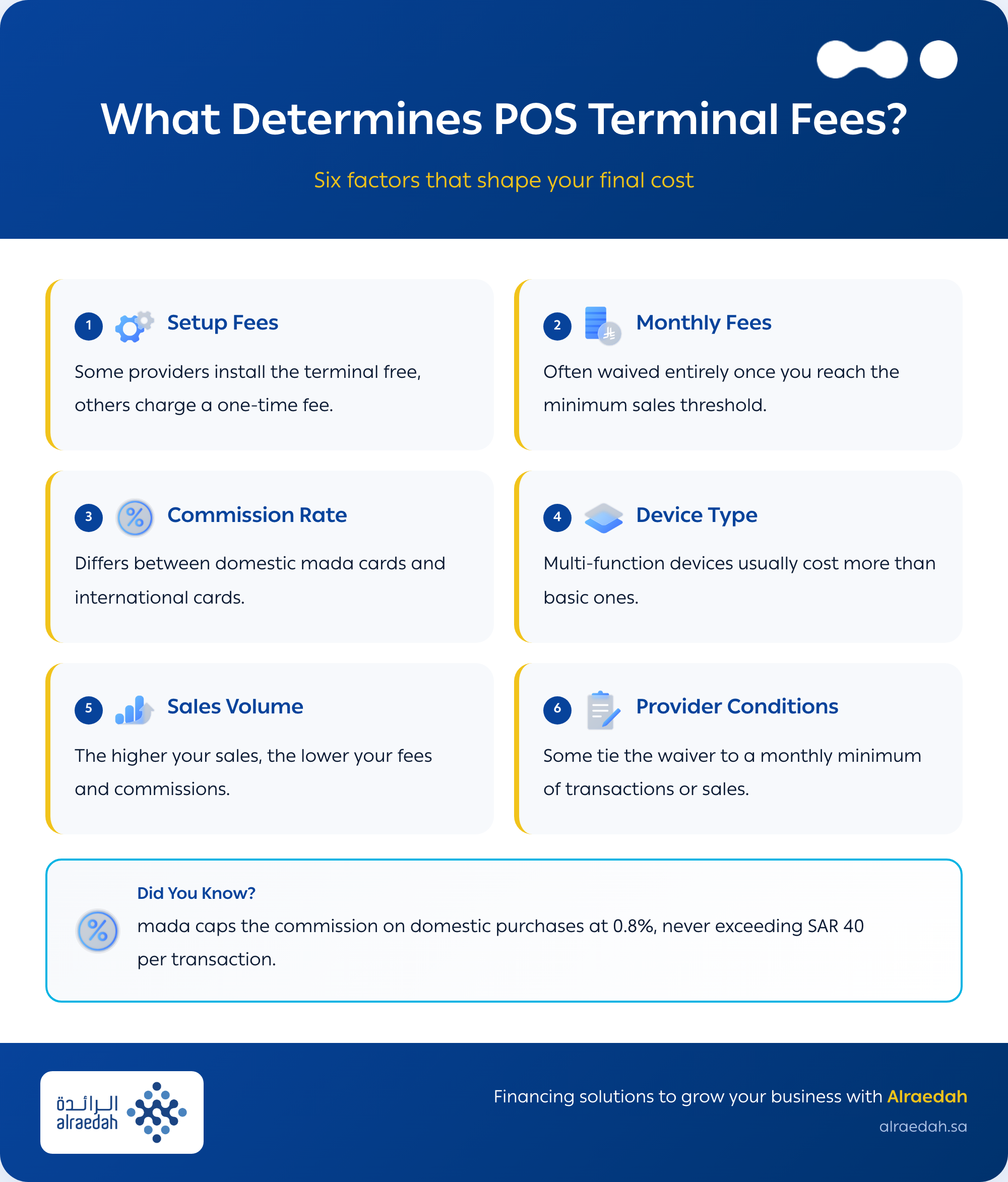
Not all POS offers in Saudi Arabia are alike, even though every one of them runs through the mada network. Several factors determine the final price and fees a merchant ends up paying:
1. Setup Or Installation Fees
Some banks and fintech providers install the terminal free of charge, while others apply a one-time fee at signing.
2. Monthly Or Annual Fees
A provider may charge a monthly fee for the terminal, and that fee is often waived once the merchant reaches a minimum sales threshold.
3. The Commission Rate On POS Transactions
Although mada caps the merchant commission on domestic transactions at 0.8%, with a maximum of SAR 40 per transaction, the rates on international credit cards and corporate cards can differ between providers.
The mada cap applies only to domestic bank cards (mada) issued by Saudi banks. When you accept international credit cards (such as Visa or Mastercard issued outside the Kingdom) or international corporate cards, the commission changes noticeably. Here banks and fintech providers are not bound by the same ceiling, and the rate typically runs between 1.5% and 3% or more, depending on the provider’s policy.
Some providers also apply a different rate to each card type:
- Personal credit cards issued locally.
- International credit cards.
- Corporate or business cards.
- Digital wallets (Apple Pay, STC Pay, and others).
These differences mean the nature of your business, and how much of it involves international customers or foreign corporate cards, directly affects your total monthly POS fees. A tourist-district restaurant serving foreign visitors, for example, will usually pay a noticeably higher rate than a store that takes most of its payments through domestic mada cards.
4. Device Type And Payment Solution
- A fixed terminal built for shops.
- A mobile terminal for takeaway orders and delivery.
- Phone-based payment solutions (SoftPOS) with no traditional device.
- Advanced or multi-function devices usually cost more.
5. Monthly Sales Volume
The higher your sales, the lower your fees and commissions, and the reverse holds too.
6. The Provider’s Additional Conditions
Some providers tie the fee waiver to a minimum monthly number of transactions or a specific sales value.
Now that you know the factors behind POS terminal prices and fees, it is time to see how they play out in practice. Below you will find a comprehensive comparison of the leading banks and fintech providers in Saudi Arabia for 2026 and 2027, covering Al Rajhi, SNB, Bank Albilad, Geidea, SurePay, and Hala. The comparison includes setup fees, monthly fees, and commission rates for the different card types.
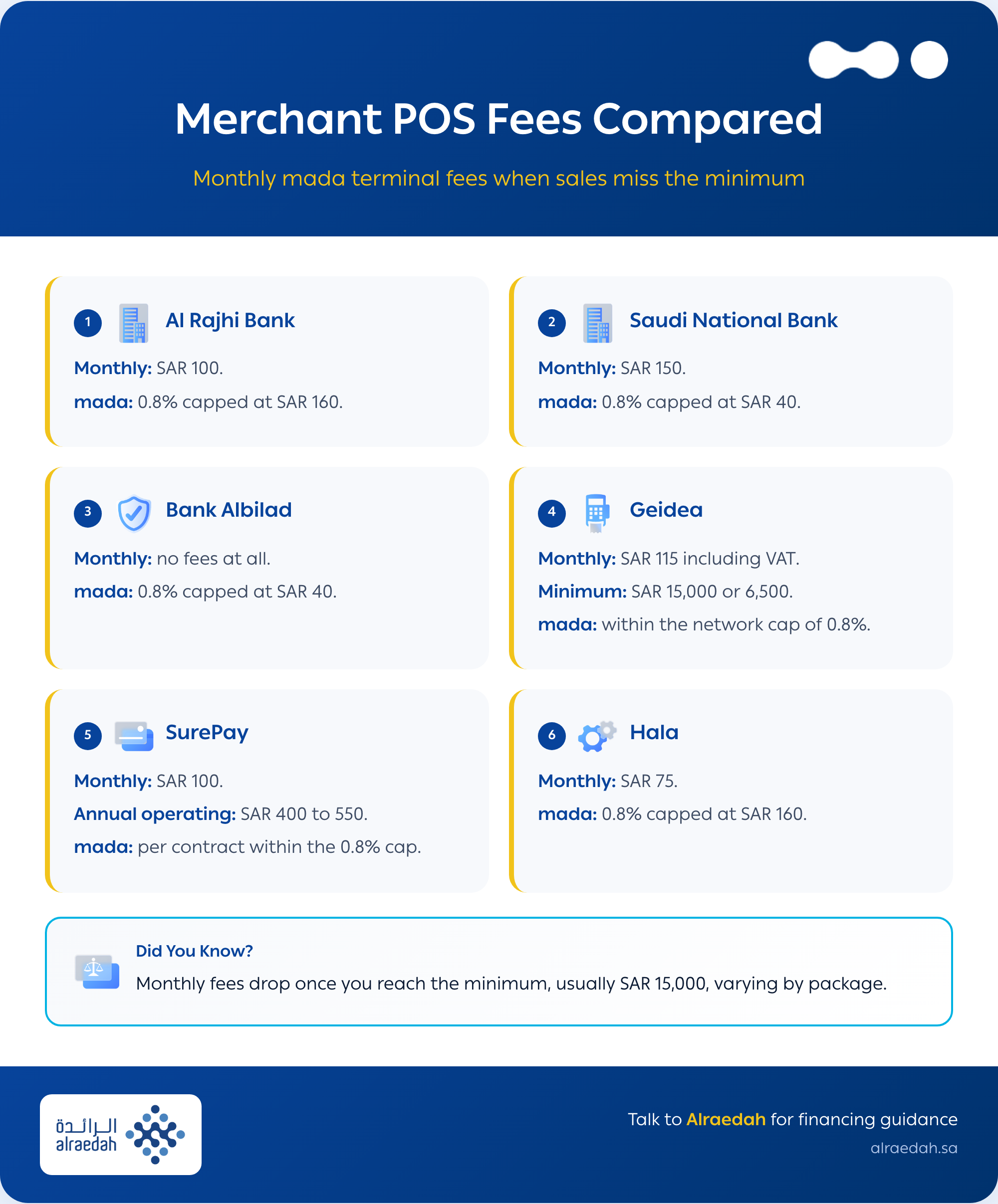
POS Terminal Merchant Fees Compared In Saudi Arabia [2026 – 2027]
| POS provider | Setup/installation fees | Monthly fees | Commission on domestic mada transactions | Commission on international cards | Additional notes | Source |
|---|---|---|---|---|---|---|
| Al Rajhi Bank | Free | Free once you reach a monthly sales threshold (SAR 15,000) If your sales fall below that amount, a monthly fee of SAR 100 + VAT applies |
mada card commission: 0.8% on transactions above SAR 100 (capped at SAR 160 per transaction). 0.7% on transactions of SAR 100 or less. Commission on domestic credit cards: Between 1% + SAR 0.10 and 2.5% depending on the business activity |
Fixed at 2.5% + SAR 0.10 per transaction | Requires a business current account with the bank. | Al Rajhi |
| Saudi National Bank (SNB) | Free | Free once you reach a monthly sales threshold (SAR 15,000); below it, a fee of SAR 150 per month applies per terminal | mada card commission: 0.8% capped at SAR 40 Commission on domestic credit cards: Between 1.75% and 2.5% depending on the activity. |
Up to 3% | SNB | |
| Bank Albilad | Free | Free (no fixed monthly fee on the terminal). | 0.8% capped at SAR 40 per transaction | 2% – 2.5% depending on card type and origin | Requires a business current account with Bank Albilad. Settlement lands the day after the transaction. The terminal comes with round-the-clock technical support. |
Bank Albilad |
| Geidea | Free (device, installation, and maintenance) | Free once you reach SAR 15,000 in monthly sales per terminal; below that, SAR 115 applies, VAT included. Geidea also offers packages with a minimum threshold of SAR 6,500 depending on the subscription type. |
0.8% within the mada network cap | Set by card type and package | Accepts mada, Visa, Mastercard, American Express, Apple Pay, and Samsung Pay. | Geidea |
| SurePay | Depends on the device and package | SAR 100 per month if sales fall below SAR 15,000. For the Vega3000 the threshold is SAR 7,000 and for the MP200 it is SAR 5,000, with the fee at SAR 50 in those cases. |
Set in the contract within the mada network cap (0.8%, maximum SAR 40) | Set in the contract by card type | Annual operating fees from the second year range between SAR 400 and 550 depending on the device. All prices exclude VAT. Licensed by the Saudi Central Bank under number 45018604. |
SurePay |
| Hala | From SAR 75 | The minimum monthly transaction volume required per POS terminal is SAR 15,000, otherwise a monthly fee of SAR 75 applies per terminal. | 0.8% commission per transaction, capped at SAR 160 | 2.5% + SAR 1 | Hala |
Swipe the table horizontally to see the remaining columns when needed.
Looking at the table, a fair question comes to mind: why do most banks call the terminal “free” while monthly fees show up at the same time? The truth is that “free” in the POS world needs careful unpacking.
The device itself is free, but the service comes with conditions
Banks hand over the POS terminal at no charge in exchange for the merchant committing to use it and run sales through it. The terminal’s price is baked into the agreement rather than billed as an extra cost.
Why Do POS Providers Enforce A Minimum Sales Policy?
Most banks and fintech providers apply a near-identical policy:
- The usual threshold: SAR 15,000 in monthly sales
- Reach it: the terminal and service are completely free
- Miss it: monthly fees of SAR 75 to 150 apply
From the provider’s side this policy makes sense, because their core profit comes from transaction commissions, not from selling devices. If your sales are too low, the provider earns too little commission to cover the terminal and support costs, so a fixed fee steps in to fill the gap.
What Happens If You Cancel The Service?
If you decide to cancel your POS service, you will need to return the terminal to the provider in most cases, because it belongs to the provider, not to you.
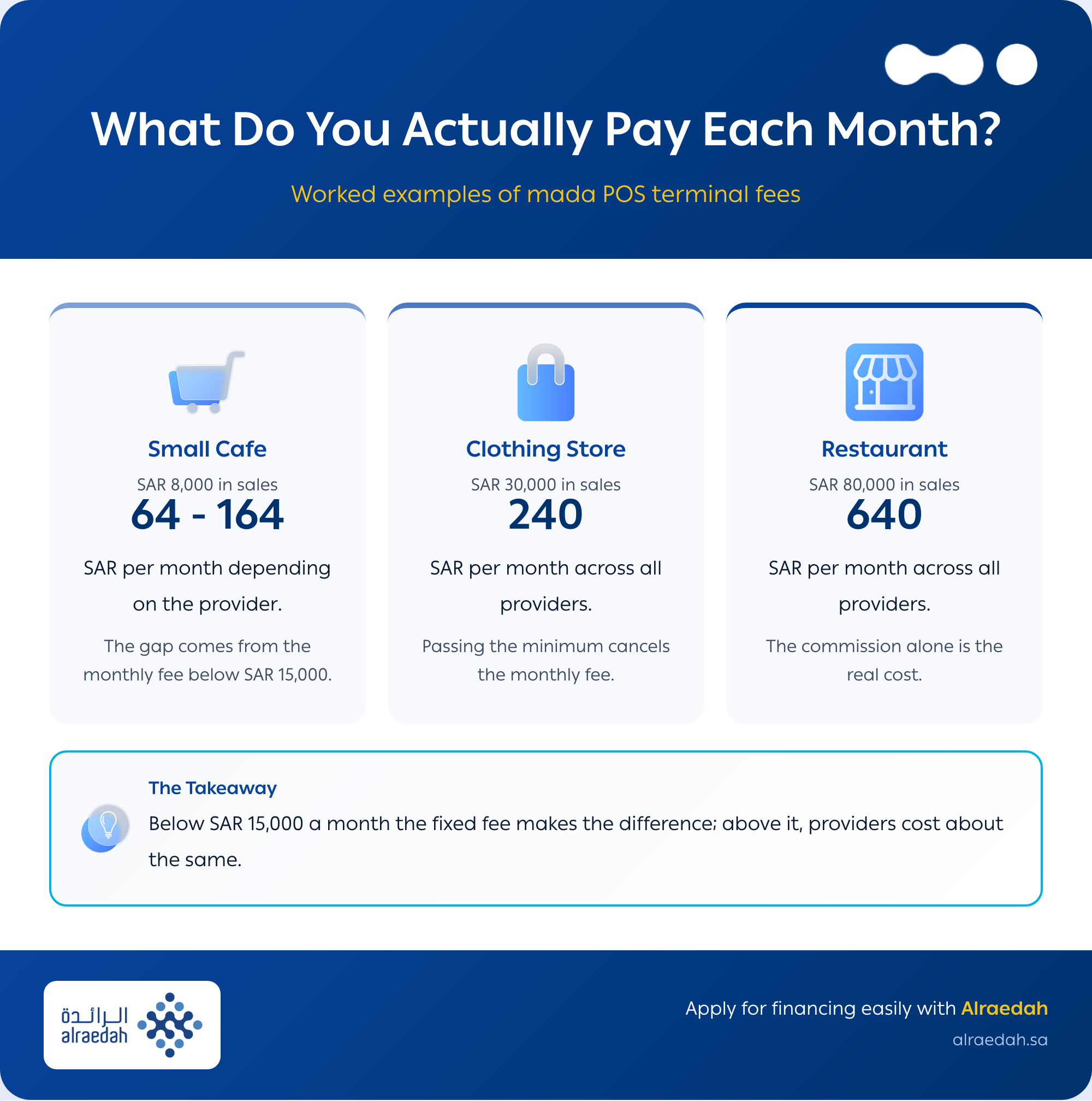
Calculating mada POS Fees On Your Sales, With Examples
Now that you understand merchant POS fees, it is time to see the real cost on your business. We will take three simple examples at different sales volumes.
[To keep the math simple, we assume all sales run through domestic mada cards only (0.8% commission)]
Example 1: A Small Cafe With SAR 8,000 In Monthly Sales
Al Rajhi Bank:
- Monthly fee: SAR 100 (sales are below 15,000)
- Transaction commission: 8,000 x 0.8% = SAR 64
- Total fees: SAR 164 per month
Bank Albilad:
- Monthly fee: SAR 0
- Transaction commission: 8,000 x 0.8% = SAR 64
- Total fees: SAR 64 per month
Example 2: A Clothing Store With SAR 30,000 In Monthly Sales
Al Rajhi Bank:
- Monthly fee: SAR 0 (threshold reached)
- Transaction commission: 30,000 x 0.8% = SAR 240
- Total: SAR 240 per month
Bank Albilad:
- Monthly fee: SAR 0
- Transaction commission: 30,000 x 0.8% = SAR 240
- Total: SAR 240 per month
Example 3: A Restaurant With SAR 80,000 In Monthly Sales
Al Rajhi Bank:
- Monthly fee: SAR 0
- Transaction commission: 80,000 x 0.8% = SAR 640
- Total: SAR 640 per month
Bank Albilad:
- Monthly fee: SAR 0
- Transaction commission: 80,000 x 0.8% = SAR 640
- Total: SAR 640 per month
The Simple Takeaway
- If your sales are under SAR 15,000 a month: Bank Albilad is the cheapest option.
- If your sales are SAR 15,000 or more: all the banks end up costing roughly the same.
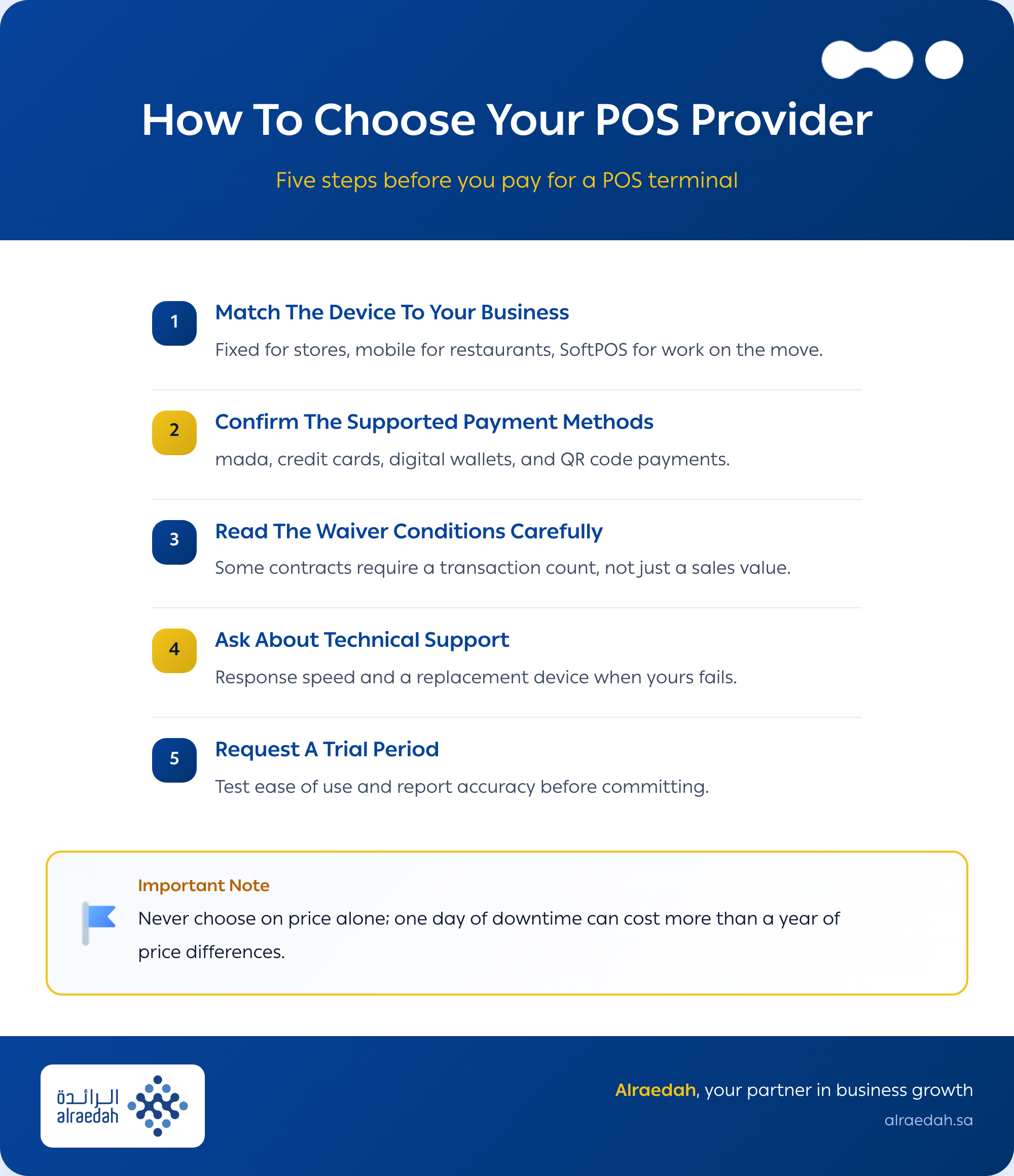
Tips For Choosing The Right POS Provider
After seeing the numbers and the math, you might think the decision is easy: pick the cheapest and move on. In reality, the terminal’s price is not the only factor that matters. Here are the tips that lead to the right call:
1. Choose Based On The Nature Of Your Business
- For fixed locations (clothing stores, pharmacies): a traditional fixed terminal with a large screen and a built-in receipt printer. Most banks provide this type free.
- For restaurants and cafes: a mobile terminal you can carry to tables, or an integrated system that connects the POS to your restaurant management software.
- For businesses on the move (delivery, events): SoftPOS apps on a smartphone, or compact mobile devices that run on Bluetooth.
2. Confirm Support For Every Payment Method You Need
Check that the terminal accepts:
- Domestic mada cards
- Credit cards (Visa, Mastercard)
- Digital wallets (Apple Pay, STC Pay, Tamara)
- QR code payments
3. Read The Fee Waiver Conditions Carefully
Some banks require:
- A minimum number of transactions (not just a sales value)
- Using the terminal for a set period before the waiver kicks in
- Linking the service to a business current account
4. Technical Support Quality
Ask about:
- 24/7 technical support availability
- Response speed when the terminal breaks down
- Technicians available in your area
- Replacement devices on standby for outages
5. Think Ahead
If you plan to expand your business:
- Choose a provider with advanced solutions (inventory management systems, detailed reporting)
- Make sure adding new terminals is easy
- Look for integration with e-commerce platforms
- Look for integration with POS financing providers.
6. Ask For A Trial Period
Most providers offer one. Use it to test:
- How easy the terminal is to use
- Transaction processing speed
- Technical support quality
- The accuracy of the financial reports
The Biggest Mistake To Avoid
Never choose a POS provider on price alone without testing the service. A terminal that is down for a single day can cost you more than a full year’s worth of price differences.
What Are The Main Problems And Drawbacks Merchants Face With POS Terminals?
POS terminals offer a fast, secure way to get paid, but they can run into several challenges, such as:
- The terminal stopping when the internet or power cuts out
- Monthly fees kicking in when the minimum sales threshold is missed
- Credit card commissions running higher than mada’s
- Extra charges for declined transactions or device maintenance.
- Bank transfers can also arrive late in some cases, and some contracts impose long-term commitments or restrictions on which card types you can accept.
All of this makes choosing the right provider, and understanding the contract terms, essential to avoiding unexpected costs or downtime.
How Do You Turn Your POS Sales Into Financing For Growth?
Now that you know what a POS terminal costs and have run the commission math on your sales, a question naturally follows: can these steady sales work for me and help grow my business?
The answer: yes, in a smart and flexible way.
If your business generates regular sales through its POS terminal (as in the examples above), you hold a valuable competitive advantage: a documented sales record that can qualify you for flexible pos financing with no guarantor.
POS Financing: The Smart Route To Growing Your Business
Rather than treating POS fees as just another cost, you can turn your steady sales into a financing opportunity that helps you:
- Expand your business or open a new branch
- Stock up on extra inventory for peak season
- Upgrade your fittings and equipment
- Cover liquidity needs for large contracts
All you need is a consistent sales record through your POS terminal for 3 months, and a business that has been active for at least 3 months.
A Practical Case From Our Earlier Examples
Remember the restaurant making SAR 80,000 in monthly sales?
- Annual sales: SAR 960,000
- Potential financing (over two years): up to SAR 365,000
- No guarantor, no fixed monthly installments
- Repayment happens automatically from the same POS sales
Or even the small cafe with SAR 8,000 in monthly sales:
- Annual sales: SAR 96,000
- Potential financing (over one year): up to SAR 20,000
- Ideal for buying extra equipment or upgrading the space
Why Does POS Financing Beat Traditional Loans?
1. No guarantor needed: approval rests on your actual sales record instead of an outside guarantor.
2. Fast approval: because your sales record is clear and documented through the POS terminal.
3. No strain on cash flow: repayment is a share of sales rather than a fixed monthly installment, which keeps your daily liquidity stable.
4. Financing of up to SAR 25 million depending on your sales volume.
Read more: POS financing requirements in Saudi Arabia
When Is POS Financing The Best Choice?
- When you want to expand fast without waiting on traditional ways of raising capital
- If you need liquidity to seize a business opportunity that will not wait
- When you prefer flexible repayment over fixed installments
- If you cannot find a suitable guarantor for a traditional loan
With the cost of a POS terminal clear and the potential of its sales in view, you now have the full picture of how to turn this device from a simple payment tool into a real growth engine for your business.
Frequently Asked Questions, Answered
Below are short answers to the questions merchants ask most often:
Are POS Terminals Free Or Paid?
The devices are usually free when contracting with banks, provided you reach a minimum monthly sales threshold (often SAR 15,000 or 20,000 depending on the bank). Miss the threshold and monthly fees of SAR 75 to 150 apply. Some banks, such as Bank Albilad, provide the terminal with no monthly fees even when sales dip.
How Are mada POS Fees Calculated For The Merchant?
Merchant fees are calculated as a commission of up to 0.8% of the transaction value (capped at SAR 40 per transaction) for mada payments, plus the monthly fee whenever the minimum sales threshold is not met. Example: a SAR 500 purchase means a commission of roughly SAR 4.
How Much Does A mada POS Terminal Cost?
Bought outright on the open market, devices range between SAR 150 and 1,500 depending on type and condition, but the major banks provide them free in exchange for a service contract.
What Is The Difference Between Traditional Terminals And SoftPOS Solutions?
- Traditional (fixed POS) terminals: suit businesses with stable sales and a fixed location.
- SoftPOS solutions: run on smartphones (Android 10+ with NFC support), carry a flat subscription fee (around SAR 43.7 per month), have no minimum sales requirement, and offer greater flexibility.
How Long Does Switching Between Providers Take When Changing POS Terminals?
Usually between 3 and 7 business days, covering cancellation of the old service, delivery of the new terminal, and opening the business account with the new provider.
How Do Credit Card Commissions Differ From mada Cards?
- mada: around 0.8%.
- Credit cards (Visa/Mastercard): between 1.75% and 2.5% depending on the bank and card type.
Are There Fees On Declined Transactions?
Some banks charge the merchant SAR 1-2 when a transaction is declined due to insufficient funds or a data entry error.
Are There Maintenance Fees On The Terminal?
It varies by bank; Al Rajhi Bank, for example, charges SAR 40 per month, while Bank Albilad provides maintenance free of charge.
What Are The Requirements For Getting A POS Terminal?
A valid commercial registration, a business current account, proof of identity for the business owner, and a suitable spot to install the device.